
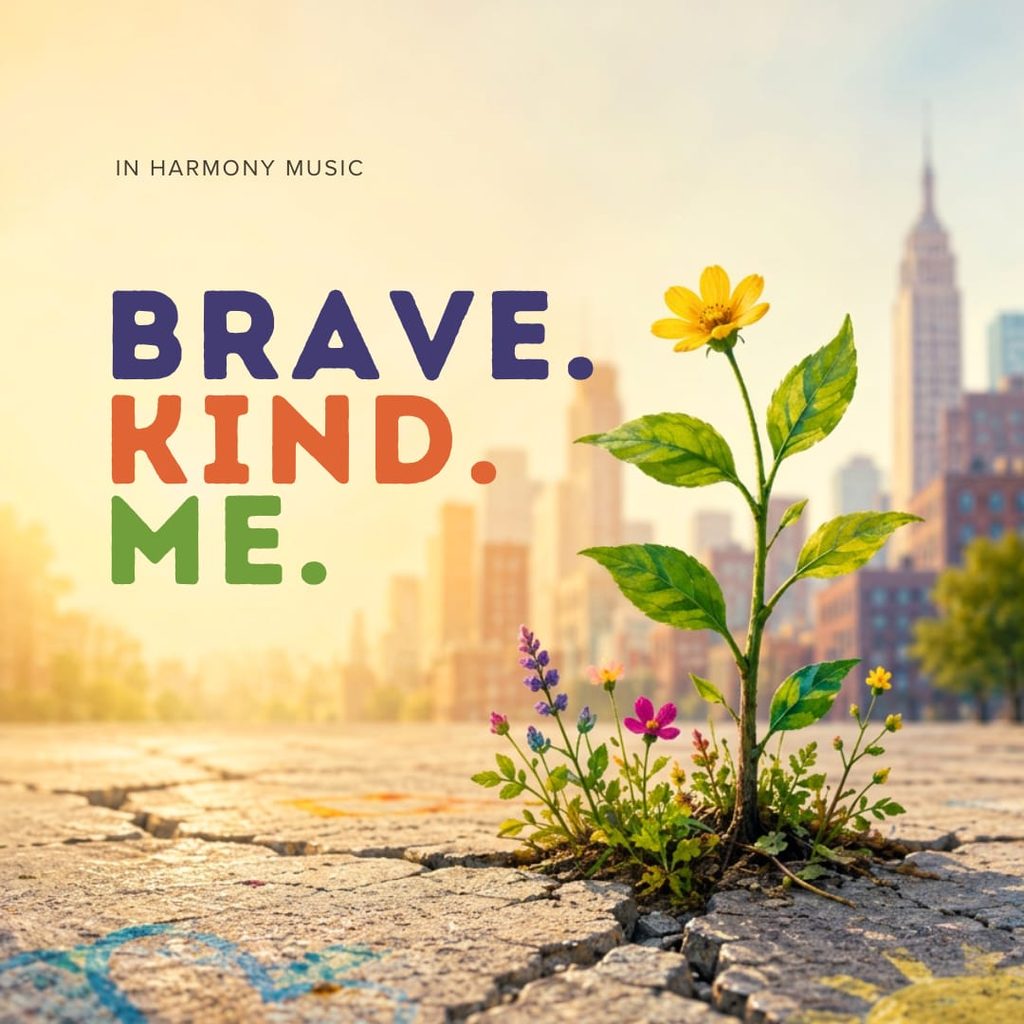
With Brave. Kind. Me., In Harmony Music brings together sophisticated musicianship, playful songwriting, and a deeper understanding of how music can shape connection, expression, and emotional life.
Children’s music occupies an unusual place in the larger music industry. It is often treated as its own category, separate from the artistic conversations surrounding songwriting, production, performance, and culture. Yet some of the most important music a person encounters may arrive during childhood, when a melody can become inseparable from memory and when repeated lyrics can help shape a child’s understanding of the world. The songs children hear early in life can become part of the emotional soundtrack of their development, connecting sound with family, friendship, movement, imagination, and discovery.
In Harmony Music’s new album, Brave. Kind. Me., approaches that possibility with unusual seriousness. Released August 30, 2026, the album combines the energy and accessibility expected of music for young listeners with a sophisticated creative perspective shaped by more than two decades of work in music education. The result is a record that considers not only what children want to hear, but what music can become in the everyday emotional life of a child.
For founder Justine Chadly, the project represents the latest chapter in a philosophy that began when she founded In Harmony Music in 2003. Her work has consistently centered music, movement, creativity, and play as ways of helping children develop confidence and connection. With Brave. Kind. Me., those ideas take the form of an album intended to be enjoyed at home, experienced in classrooms, shared between families, and ultimately remembered as part of childhood itself.
Music That Meets Children Where They Are
The emotional world of the album is expansive without becoming heavy. Its songs address belonging, friendship, empathy, difference, and self expression, but they do so through the language of music rather than through direct instruction.
We All Belong considers inclusion and difference, while My Friends explores the everyday negotiations that define childhood relationships. A Little Bit of Love approaches empathy with warmth and simplicity. Alongside these more reflective songs are tracks such as Elbow Macaroni and Baila, which embrace movement and humor and remind listeners that emotional well being is also connected to the ability to play.
That mixture gives the album its particular character. It does not present childhood as a problem that needs to be solved. Instead, it recognizes childhood as a period of discovery in which joy and uncertainty exist alongside one another. Children can be learning how to navigate friendship one moment and dancing simply because a song makes them want to move the next.
Music accommodates both experiences, which is part of its unique power. It can provide structure without demanding rigidity and expression without requiring a child to explain everything they are feeling. A familiar melody can create comfort, while rhythm can provide a physical outlet for energy and emotion. In Harmony’s approach allows those experiences to coexist naturally.
The Space Between Entertainment and Wellness
The relationship between music and well being has become an increasingly important part of cultural conversation, but the concept is sometimes reduced to its most clinical applications. Music can certainly play a role in therapeutic environments, but its influence on emotional life also occurs through ordinary experiences: singing together, moving to rhythm, repeating familiar songs, laughing at a silly lyric, or finding comfort in something recognizable.
This is where In Harmony’s approach becomes particularly interesting. Brave. Kind. Me. does not position itself as a therapeutic intervention. Instead, it creates opportunities for connection. The distinction is important. The album is not asking music to replace professional support or solve complex childhood challenges. It is recognizing the role that music can play in creating environments where children and adults feel comfortable communicating.
A song can give a parent a way to begin a conversation that might otherwise feel difficult. It can help a teacher introduce a subject without immediately turning it into a lecture. It can allow children to express an emotion physically through movement before they have the words to explain it. In that sense, music becomes part of the emotional architecture of everyday life, providing a shared experience through which children and adults can connect.
A Record Built by Musicians
The album’s philosophy would not have the same impact without its musical foundation. Tom Foote brings extensive experience as a drummer, producer, composer, and creator of music for children and educators around the world. His work gives the project a broad sonic vocabulary, allowing Brave. Kind. Me. to move across musical styles while remaining coherent and accessible.
That musical diversity is important because children are listeners before they are consumers of categories. They do not necessarily experience music according to industry classifications. They respond to rhythm, repetition, melody, energy, humor, and emotion. A sophisticated musical arrangement can therefore be engaging to a child without needing to be simplified to the point of losing its character.
In Harmony’s approach respects that capacity. The album is created for young listeners, but it is not made as though young listeners are incapable of appreciating musical quality. The songwriting, arrangements, vocals, and production are treated as meaningful components of the experience rather than merely vehicles for delivering an educational message.
Loomis, who performed on several tracks, has described the album as raising the bar within children’s music and music education, pointing specifically to its songwriting, vocal performances, production, and arrangements. His perspective as a working musician reinforces the idea that children’s music can be both purposeful and artistically credible.
The People Who Came Back
There is another dimension to the album that gives its music an unusual emotional weight. Several of the musicians who appear on Brave. Kind. Me. were once students of Chadly.
Their presence creates a kind of musical lineage. A child enters a classroom, discovers music, develops a creative identity, grows into an adult, becomes a musician, and eventually returns to contribute to the work of the person who first helped open that door. Few album credits can tell a story quite like that.
For Chadly, the participation of former students is a natural extension of her educational philosophy. Her goal has never been to keep children dependent upon the teacher or institution. It has been to give them the confidence to develop their own creative voices. The fact that some of those voices have returned to her project years later offers a powerful illustration of what that philosophy can produce.
The album therefore carries a second meaning beneath its songs. It is a record about children discovering themselves, created in part by adults who once experienced that same discovery firsthand.
From the Classroom to Family Life
The most successful children’s music often escapes the environment for which it was originally designed. It moves from classrooms into cars, kitchens, bedrooms, playgrounds, and family routines. In Harmony’s new album appears designed with that kind of life beyond the classroom in mind.
Parents can listen alongside their children without feeling that they are participating in a lesson. Educators can incorporate the songs into classroom experiences without needing to transform them into curriculum. Children can encounter the album simply because they enjoy it.
That flexibility is part of what makes the project relevant to a broader conversation about family culture and well being. In a period when many parents are looking for healthier ways to create connection and many educators are searching for experiences that support the whole child, music offers something that is both structured and open ended.
It gives people something to do together. That may sound simple, but shared attention has become increasingly valuable in a culture in which families and children are surrounded by competing forms of digital stimulation. A song creates a common point of focus. It can bring people into the same room, the same rhythm, and sometimes the same emotional experience.
A Broader Philosophy of Childhood
The album also reflects the larger work of the In Harmony Foundation, which extends the organization’s mission through relationships with schools, libraries, therapists, and community partners supporting children experiencing isolation, trauma, and disconnection.
The foundation’s work reinforces an important principle behind the music: connection is not a luxury in childhood. It is foundational. Children need environments where they can feel understood, participate, create, and develop a sense of belonging.
Music cannot provide all of those things by itself, but it can help create the conditions in which they become possible. It can offer repetition and familiarity, encourage participation, create opportunities for shared experience, and give children a form of expression that does not depend entirely on verbal communication.
That may ultimately be the most compelling quality of Brave. Kind. Me. The album does not attempt to tell children who they should become. Instead, it creates a musical space in which they can explore friendship, kindness, confidence, difference, and identity while remaining free to laugh, move, play, and simply enjoy themselves.
For Justine Chadly, that represents more than twenty years of work coming together in one project. For the former students now contributing as musicians, it represents a return to where their own creative journeys began. And for the children listening today, the album may become something far more personal: a collection of songs attached to a particular period of growing up.
That is the lasting power of music. A record can begin as a collection of tracks, but over time it can become memory, language, ritual, and connection. With Brave. Kind. Me., In Harmony Music is making the case that children’s music can do all of those things while remaining genuinely enjoyable to hear.
The result is not simply an album about childhood. It is an album designed to become part of it, offering children and the adults around them music that can be enjoyed, remembered, shared, and carried into everyday life.
Learn more about In Harmony Music: InHarmonyMusic.com
Follow In Harmony Music: Instagram | Facebook | YouTube
Follow In Harmony Foundation: Instagram | YouTube



